WARP Lab — Featured Research
WARP: World Maps, Autonomy, Robotics and Perception Lab

The WARP lab is led by Pedro F. Proença. Our group is part of NOVA-LINCS within Universidade Nova de Lisboa, FCT.

We are a research group focused on robotics and computer vision. We are interested in developing practical autonomous systems that can work robustly under challenging conditions (e.g. perceptually degraded environments).

News

Sep 2025 🚀 WARP Lab launched at NOVA-LINCS, Universidade NOVA de Lisboa.
Sep 2025 AnalogDepth preprint released on arXiv →
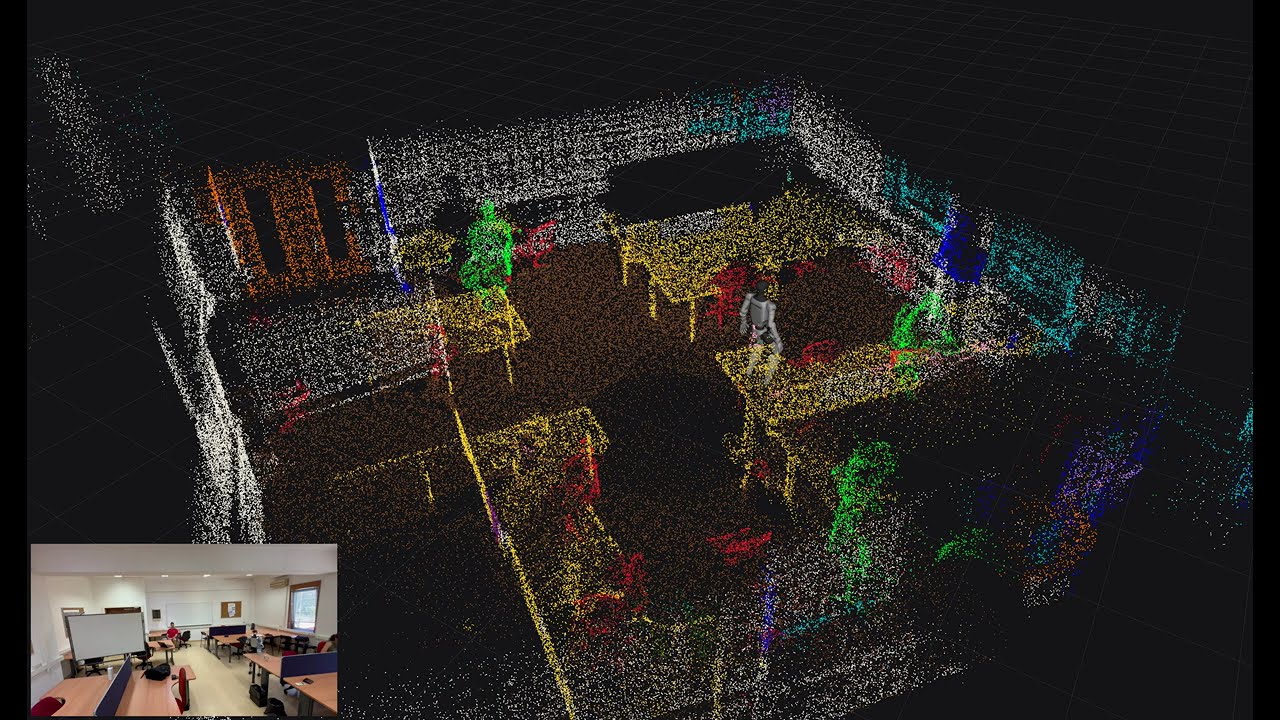
Sep 2025 Lectures on Robotics Perception: Fundamentals now public on YouTube →

Research Highlights

1 publication
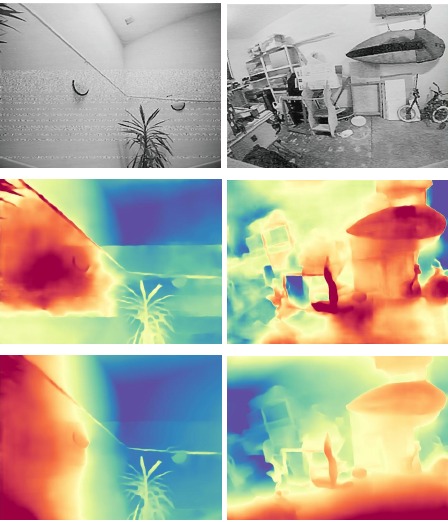
AnalogDepth Fig 1 — depth estimation on analog FPV imagery

AnalogDepth: Multi-view Geometry from FPV Drones under Analog Video Transmission

A. Amorim, P. F. Proença

Analog video transmission (VTX) remains widespread in FPV drones due to low latency, weight and cost, but suffers from complex spatially structured image degradation that standard AWGN augmentation does not capture. We present AnalogDepth, a parameter-efficient pipeline that adapts Depth Anything 3 to analog FPV imagery via student-teacher knowledge distillation with LoRA injected into the DINOv2 backbone, using a real noise bank built from static FPV recordings across diverse conditions.

Read paper →
Previous Research

4 publications
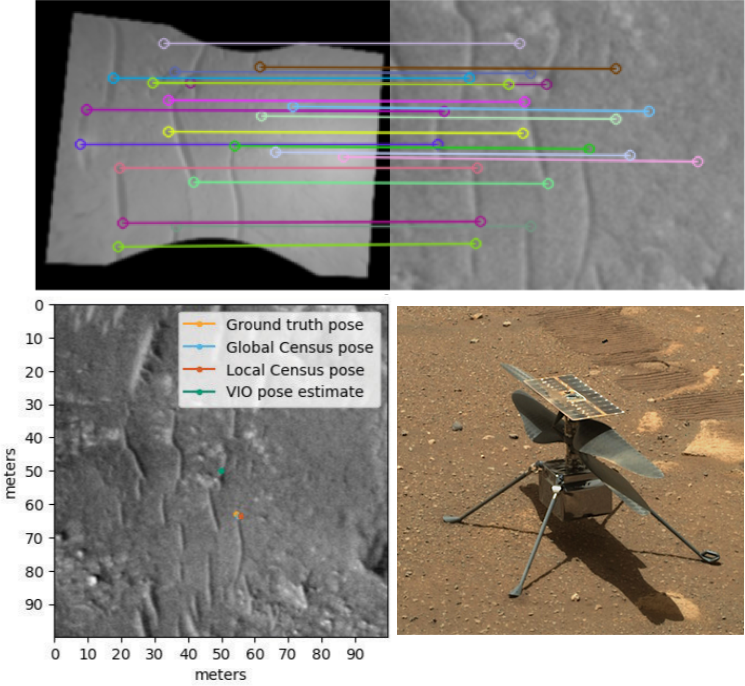
Mars Ingenuity helicopter global localization — feature matching and trajectory
IEEE Transactions on Field Robotics 2025

Onboard Autonomous Health Assessment and Global Localization for the Mars Helicopter: Towards Multi-flight Operations

C. Basich, C. Mauceri, G. Kubiak, J. Delfa, A. Candela, P. F. Proença, B. Ridge, S. Chien

NASA's Ingenuity helicopter completed 72 flights on Mars — 15× its planned scope — but required human engineers to localize the vehicle and assess flight readiness between each flight, prohibiting autonomous multi-flight operation. We propose an onboard autonomy framework that replicates this ground cycle, with a focus on global localization: autonomously estimating the helicopter's position from onboard imagery, enabling future systems such as the Mars Science Helicopter and Dragonfly to operate without ground-in-the-loop constraints.

Read paper →
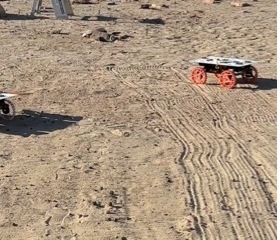
CADRE development model rovers on sandy terrain
IEEE Aerospace 2024

Multi-agent Autonomy for Space Exploration on the CADRE Lunar Technology Demonstration

J.-P. de la Croix, F. Rossi, R. Brockers, D. Aguilar, K. Albee, E. Boroson, A. Cauligi, J. Delaune, R. Hewitt, D. Kogan, G. Lim, B. Morrell, Y. Nakka, V. Nguyen, P. F. Proença, et al.

CADRE is a lunar technology demonstration employing a team of three autonomous rovers and a base station designed to land at the Moon's Reiner Gamma region. Receiving only high-level tasks from Earth, the rovers independently survey lunar terrain and execute distributed radar measurements through collaborative coordination, advancing multi-agent autonomy for future planetary science missions.

Read paper →
Spacecraft pose estimation — photorealistic rendered examples
ICRA 2020

Deep Learning for Spacecraft Pose Estimation from Photorealistic Rendering

P. F. Proença, Y. Gao

We address 6D pose estimation for spacecraft during orbital proximity operations. We present URSO, a simulator built on Unreal Engine 4 that generates photorealistic labeled training images. Our deep learning framework employs orientation soft classification, modelling orientation ambiguity as a mixture of Gaussians. Validated on synthetic datasets and the ESA pose estimation challenge, achieving 2nd place on real imagery.

Read paper →
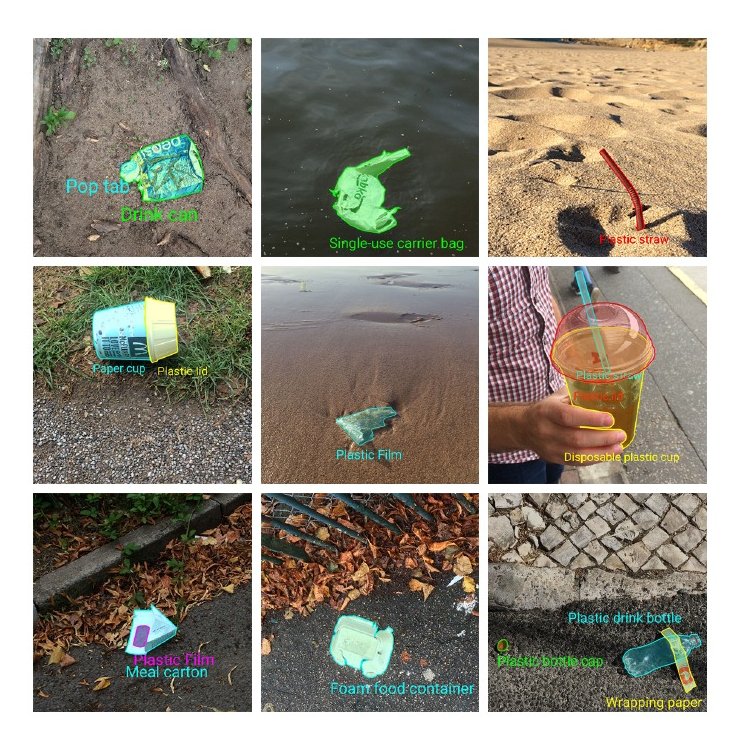
TACO dataset Fig 1 — annotated litter samples
arXiv 2020

TACO: Trash Annotations in Context for Litter Detection

P. F. Proença, P. Simões

TACO is an open image dataset for litter detection and segmentation, growing through crowdsourcing. We describe the dataset and its supporting tools, and report instance segmentation performance using Mask R-CNN. Despite its modest size — 1500 images and 4784 annotations across 60 litter categories — results are promising for this challenging real-world detection problem.

Visit dataset →

Contact

WARP Lab · NOVA-LINCS
Departamento de Informática
Faculdade de Ciências e Tecnologia
Universidade NOVA de Lisboa
Campus de Caparica
2829-516 Caparica, Portugal
Undergraduate · MSc & BSc
Student Opportunities

We are always on the lookout for outstanding and motivated students to undertake MSc thesis projects and support robotics research projects.

Doctoral Studies
PhD Applications

Our lab currently has no funding for PhDs, however for strong candidates, we may support the preparation of an application for national or EU grants.